Showing posts with label News. Show all posts

You are Pinoy if

People are different and so are Filipinos, because we have our own culture, style, and way of living. Our looks are different, some are white, black, mistiza, malay, chinese, but whatever we look like, there is always a trademark of a 100% pinoy.

You are Pinoy if


1. You use dipper or tabo when taking a bath.
2. You love to buy on "sale" in shopping malls even if you dont need them
3. Your dining area has a picture of the "last supper".
4. You eat with your bare hands.
5. You eat balut
6. You don't fall in line
7. Can sing the National anthem Lupang Hinirang but calls it Bayang Magiliw.
8. You dip the bread or pandisal on the coffee.
9. Whenever there is something going on like a fire or someone dead, you are always curious and will go to that place even if it is too dangerous.
10. You like to spit or take a pee wherever you like.
11. You love to sing, even if your voice sucks.
12. You like to buy ukay ukay or used clothing.
13. A big wooden spoon and fork are hanging in your walls.
14. Proud of Manny Pacquiao, Lea Salongga or Charice, who is very famous around the world.
15. Proud of famous half breed Filipinos like, Batista, Erik Spoelstra, Rob Schneider, Nicole Scherzinger.
16. Collect bottles and use it to put sugar, salt, soy sauce.
17. You call nail polish "cutex" and Colgate for toothpaste.
18. You like pirated CD's and DVD's.
19. Scratch your head if you do not know the answer.
20. You have an electric fan without its front cover.
21. You use detergent soap for dishwashing.
22. You make coffee a soup for your rice.
23. When there is a party, you bring cellophane and bring some of the food back home.
24. Can text the whole day.
25. When you see a celebrity, you get excited and always wanted a picture with him/her.
26. You like to sing Kpop songs even you can't understand a damn thing they are singing.
27. You liked and watched Meteor Garden.
28. Loves Champurado with tuyo.
29. Love playing Basketball.
30. Yell a lot while playing DotA on computer shops.
31. You borrow from sari- sari store.
32.You put 25 cents on you ear.
33. You watch noontime game shows.
34. During election, politicians can buy your vote.
35. You love going to fiesta on different barangays.
36. Can't live without rice when eating.
37. Like to sabit on the jeepney.
38. Can speak Carabao English.
39. You use the term bahala na which means uncertain, unknown or doesn't care at all.
40. You feel tired and sleepy on the afternoon, like 3 pm.
41. Late for any appointment.
42. Attend a funeral so that you can gamble.
43. You say "po" and "opo" when speaking to someone older than you.
44. You own a karaoke system.
45. You say "brown out" instead of "black out".
46. You own a piano and no one plays it.
47. You have a walis tambo or walis tingting even if you already have a vacuum cleaner.
48.You use rock to scrub in the shower.
49. You point using your lips.
50. You put your foot up on your chair and rest your elbow on your knee while eating.


Transgender women are now allowed to enter miss Universe

Miss Canada's Jenna Talackova is the first
transgender to enter the miss Universe Pageant
AFP--Donald Trump's Miss Universe contest on Tuesday threw open its doors to transgender models, allowing men who have had a sex change the chance to be crowned the world's most beautiful woman.

The transgender contestants will be able to strut their stuff in the international beauty championships starting in 2013, while pioneering sex-change model Jenna Talackova will be allowed to take part this year, said gay and transgender rights organization GLAAD.

"The Miss Universe Organization today follows institutions that have taken a stand against discrimination of transgender women including the Olympics," said Herndon Graddick, a spokesman for the Gay and Lesbian Alliance Against Defamation.

"At a time when transgender people are still routinely denied equal opportunities in housing, employment and medical care, today's decision is in line with the growing levels of public support for transgender people across the country."

Paula Shugart, president of the Miss Universe Organization, said on GLAAD's website: "We have a long history of supporting equality for all women, and this was something we took very seriously."

The reversal of longstanding policy followed a campaign by Talackova, a statuesque, blonde transgender model from Canada, who says she underwent surgery to become a woman because she was born in "the wrong body."

The Miss Universe organization, owned by flamboyant and controversial real estate magnate Trump, cited a rule that contestants, who appear before judges in a variety of gowns and skimpy clothing, must be "naturally born" women.

Backed by GLAAD and celebrity feminist lawyer Gloria Allred, Talackova took on the system, arguing, as Allred said, that "she did not ask Mr Trump to prove that he is a naturally born man. Or to see the photos of his birth to view his anatomy to prove that he was male."

Talackova, 23, underwent her sex change operation when she was 19 and is identified on her Canadian passport as a woman.

Miss Universe gave in last week, saying it would "allow Jenna Talackova to compete in the 2012 Miss Universe Canada pageant provided she meets the legal gender recognition requirements of Canada, and the standards established by other international competitions."

Tuesday's announcement saw that ruling expanded to include all transgender beauty hopefuls.

Miss Universe is "close to finalizing" the wording of the new policy but it "includes transgender women in time for the start of this fall's 2013 pageant season; a time when most of the competitions around the world begin to take place."

The entry of transgender contestants does not actually mean that any woman can vie for the crown. Not only must hopefuls be between 18 and 26 years old, one major taboo remains: motherhood.

"No, contestants may not be married or pregnant," the missuniverse.com/missusa website says.

"They must not have ever been married, not had a marriage annulled nor given birth to, or parented, a child. The titleholders are also required to remain single throughout their reign."

The 2011 Miss Universe winner was 25-year-old Leila Lopes, Miss Angola, who told judges she was so beautiful she "wouldn't change a thing," but her best trait was her "inner beauty."

Why is electricity expensive in the Philippines


Electricity is one of the most important facilitating modern activities and country’s development. Through time, the importance of electricity to people’s life has only increased.

On this ground, more efficient and reliable provision of electricity is desirable for the society.

This paper first examines past and present development of the electricity sector in four Southeast Asian countries–Thailand, Malaysia, Indonesia and the Philippines.

It then, discusses lessons learned from the past experiences and provides policy recommendations for the four countries.

****

In developing countries, the surge of high demand for electricity began after the World War II. Electricity was one of the most crucial infrastructures facilitating modern development and industrialization. With advices and supports from the cold-war superpowers and multilateral development agencies, especially the World Bank, many developing countries adopted the state-led model and established their state-owned electricity enterprise (Williams and Ghanada, 2006). Thailand, Malaysia, Indonesia and the Philippines were among them. Prior to the late 1980’s, electricity production and transmission was owned by a state-own monopoly: EGAT in Thailand, National Electricity Board (NEB) in 11 peninsula states of Malaysia, Sabah Electricity Board (SEB) and Sawawak Electricity Supply (SESCO) in Borneo states of Malaysia, Perusahaan Umum Lishtrik Negara (PLN) in Indonesia and National Power Corporation (NAPOCOR) or (NPC) in the Philippines.
In these countries, development of electricity sector varied by speed and direction. The fact that Indonesia and the Philippines contain several small islands makes electricity distribution difficult. In 1990, electrification rate was 37.3 percent in Indonesia, 54.6 percent in the Philippines and 92.7 percent in Thailand (World Bank Publication, 1994). High electricity demand due to rapid economic growth in the cities also caused electricity blackouts during the peak hours (Sharma et al., 2004).

Facing financial constraint, the government of Indonesia and the Philippines had to legalize IPPs to produce additional electricity supply. In 1989, the Philippines was the first of the four countries to allow independent power producers (IPPs). By the end of 1993, more than 25 IPPs were producing electricity in the Philippines and the power shortage problem was resolved (Abrenica, 2004)

As in 2007, the electricity industry in Thailand, Malaysia, Indonesia and the Philippines is still highly vertically and horizontally integrated. The generation is still operated by either a state-owned monopoly (Thailand, Indonesia and the Philippines) or a corporation heavily controlled by the government (Malaysia). At the wholesale level, there is very little to no competition. Transmission is generally monopolized. Distribution is monopolized in Malaysia and locally monopolized in Thailand, Indonesia and the Philippines.

Next, we evaluate privatization and reform policies adopted by the four countries.

Philippines privatization and reform policies

When we abstract away from market imperfection–i.e. political influences and transaction costs–competitive conduct and higher efficiency could be achieved. To promote competition in the wholesale market, the government could privatize the state-owned enterprise, split it into smaller companies and let those companies compete in a competitive manner with all other IPPs. As for the retail market, the government could allow more companies to serve this function. Competition is believed to result in higher efficiency and lower price.
In reality, the electricity industry is very complex. First of all, the monopoly state-owned enterprise is subject to much control from the government. The rational behind many policies adopted in the past could be explained by pure politics. Second of all, electricity production requires high initial investment and takes a long time to break even. In developing countries, where the government still wants to attract private investors into the production field, rigorous competition could discourage them. Third of all, restructuring, unbundling and break-up of companies are often time irreversible. It takes time and has to be well-planned because unsuccessful outcome could result in great and unnecessary lost.

3.1 Privatization

In theory, privatization could lead to the following achievements: 1) private companies are subject to less counterproductive interference by the government, 2) if the government is financially constrained, privatization is a means to raise money and 3) foreign private investors could bring skills and technology to the country (Thomas, 2006). In practice, however, those achievements are not always realized. Factors such as politics and inefficient contracts can lead to anti-competitive and efficient conducts.
In Thailand, Malaysia, Indonesia and the Philippines, privatization took two forms. One is through allowing IPPs and another is through privatizing the state-owned enterprise. We next discuss each of these issues in detail.

3.1.1. IPPs

During the late 1980’s to early 1990’s, the government of Thailand, Malaysia, Indonesia and the Philippines legalized IPP to allow private participation in the electricity sector. The Philippines was the first among the four countries to allow IPPs. During the late 1980′s and early 1990′s, the country’s rapid economics growth led to high electricity demand. Blackouts of up to 10 hours were common and their economic cost was substantial (Sharma et. al., 2004). In 1989, the first IPP contract was signed. By the end of 1993, more than 25 IPPs were producing electricity in the Philippines and the power shortage problem was resolved (Abrenica, 2004). However, inequitable contracts and brought about large financial burden to the government (Abrenica, 2004). In 2001, about 41 percent of electricity is produced by IPPs and the rest by NAPOCOR (Woodhouse, 2005)

3.2. Wholesale Competition


The legalization of IPPs in Thailand, Indonesia, Malaysia and the Philippines provides a good foundation to promote competition in the wholesale market. Currently, however, IPPs directly supply to the national electricity authority under inflexible long-term bilateral contracts. There is very little to no wholesale competition in the wholesale market.

Encouraging competition in the wholesale market is risky when the market is not mature and there exist dominant sellers. Negotiation failure between sellers and buyers can lead to power shortage. Abuse of dominant power by big sellers can drive smaller firms out of the market. In the case of UK, Norway, Alberta and California, failure of market reform is resulted by “market power abuse of a few dominant sellers” (Woo et al., 2003). Thus, as long as the markets in Thailand, Malaysia, Indonesia and the Philippines are still dominated by a state-owned monopoly, competition in the wholesale market should not be enforced.

3.3. Retail Competition

Providing choices of retail services has not been taken seriously in Thailand, Malaysia, Indonesia and the Philippines. This is because the countries have been focusing on delivering electricity to rural communities and guaranteeing peak-load supply in the cities.

3.4. Unbundling

Unbundling of the four functions of the electricity sector–generation, transmission, distribution and retail–has been taken into consideration when countries make plans for privatization. In 2001, the Philippines government approved of a full privatization of the electricity sector through the Electricity Power Industry Reform Act (EPIRA) (Thomas, 2006). This includes unbundling generation, transmission, distribution, and retail services. As in 2007, the Philippines has already split the National Transmission Company (TRANSCO) from NAPOCOR. Both TRANSCO and NAPOCOR will be privatized, but the implementation has been delayed (Thomas, 2006).

3.5. Introduction of Independent Regulator

Since competition in the electricity sector is far from perfect, a regulatory body is needed to mimic competitive market conducts, promote efficiency and ensure fair practices. To achieve such outcomes, a regulatory body should be independent from political influences and understand complex conditions and problems of the electricity sector in each market. So far, none of the four countries has established a regulatory body to serve such functions.


4. Summary and Conclusion

During the late 1980’s to early 1990’s these four countries started to legalize IPPs to promote private participation in the electricity generation field. These IPPs alleviated the power shortage problem in Indonesia and the Philippines and served as an initial step towards market liberalization in all four countries. Since power plants are expensive, electricity demand is unpredictable and it could take a long time for the company to breakeven, the government had to provide them some insurance for healthy profit. This includes take-or-pay, dollar-pegged payment, and guaranteed rate of return clauses. Throughout the past decade, especially right after the Asian financial crisis in 1997, the governments have been struggling to meet these obligations.
It is, however, possible for the government to achieve more equitable contracts through renegotiation. Lessons learned from past experiences reveal that the take-or-pay and dollar-pegged clauses are very risky. When countries are hit by unforeseeable economic crisis and reduction in demand for electricity, the governments would have no choice but to pay for unutilized capacity. If the payment is in other currencies, currency devaluation would result in even greater loss. Here, contract renegotiation is a means to achieve equity. In the Philippines, the government renegotiated some of their IPP contracts and believed to have saved at least US$ 1 billion (Thomas, 2006).

In this paper, we first examine development towards liberalization and privatization of the electricity sector in four Southeast Asian countries-Thailand, Malaysia, Indonesia and the Philippines. During the late 1980’s to early 1990’s these four countries started to legalize IPPs to promote private participation in the electricity generation field. These IPPs alleviated the power shortage problem in Indonesia and the Philippines and served as an initial step towards market liberalization in all four countries. Since power plants are expensive, electricity demand is unpredictable and it could take a long time for the company to breakeven, the government had to provide them some insurance for healthy profit. This includes take-or-pay, dollar-pegged payment, and guaranteed rate of return clauses. Throughout the past decade, especially right after the Asian financial crisis in 1997, the governments have been struggling to meet these obligations.

It is, however, possible for the government to achieve more equitable contracts through renegotiation. Lessons learned from past experiences reveal that the take-or-pay and dollar-pegged clauses are very risky. When countries are hit by unforeseeable economic crisis and reduction in demand for electricity, the governments would have no choice but to pay for unutilized capacity. If the payment is in other currencies, currency devaluation would result in even greater loss. Here, contract renegotiation is a means to achieve equity. In the Philippines, the government renegotiated some of their IPP contracts and believed to have saved at least US$ 1 billion (Thomas, 2006).

In many cases, however, equity may not have been the objective in the first place. IPP permits in Malaysia and the Philippines are mostly granted through nontransparent processes to investors with connections and cronies (Smith, 2003) (Seymour and Sari, 2002). The permit winners usually received contract terms that greatly favor them. Here, although it is possible for the government to cut their loss through renegotiation, they may not choose to. Apart from the complexity of the electricity sector itself, politics is also an important cause of inefficiency.

Other than the legalization of IPPs, market liberalization through other means in the four countries has been limited. We analyzed the electricity sector liberalization in five aspects–privatization, wholesale competition, retail competition, unbundling and introduction of independent regulation. The idea to progress towards each of these aspects has long been discussed in all the countries. However, the implementation has been very slow. In Thailand, privatization of the state-owned enterprise has been strongly opposed by the EGAT’s employees union. They claimed that it could lead to higher electricity price, nontransparent allocation of shares and takeover by foreigners. In Malaysia, the government corporatized 30 percent of Tegana. The company is still mostly controlled by the government and the corporatized shares were allocated people with connections and cronies. In Indonesia and the Philippines, privatization of PNL and NAPOCOR has been planned, but not yet executed.

Privatization would be useless if it does not bring about any competition and efficiency gain. In Malaysia, liberalization of Tenaga did not increase competition in the wholesale market and did not necessarily promote efficiency. It seems that the only obvious result was wealth transfer from the public to shareholders. In the case of Thailand, Thaksin’s privatization without liberalization of EGAT is likely to yield a similar result. If competition and efficiency are not achieved, any form of privatization would be meaningless.

Wholesale and retail competitions are still not yet developed in the four countries. This might be because the current market structure does not facilitate wholesale competition. As long as the state-owned monopoly has not been privatized and divested into smaller companies, the monopoly will tend to abuse its dominant power (Woo et al., 2003). As for the retail market, competition and more choices could help increase consumer’s surplus. However, as long as privatization and wholesale competition has not been implemented, retail competition is unlikely to result in much gain. As for unbundling, without competition in the wholesale and retail markets, the process would not be meaningful.

An independent regulator is what all the countries need. However, the process of establishing one is not easy. First of all, the government of Thailand, Malaysia, Indonesia and the Philippines need to let the regulator be independent of all the political influences. In these countries where politics plays a very important role in the electricity sector, the process of establishing an independent regulator could be difficult if not impossible. Second of all, an effective regulator must have a comprehensive understanding of the electricity sector (both in general and in its specific country). It takes a long time for the regulator to learn and acquire expertise to become effective (Thomas, 2006).

From the past experiences, we learned from Thailand, Malaysia, Indonesia and the Philippines that electricity reform is a very delicate issue. For most countries in the world, privatization and market liberalization are adopted as means to achieve the sole objective of reform–highest achievable efficiency. For the four countries discussed in this paper, efficiency was usually overlooked or used as an excuse to fulfill many political objectives. In Thailand, for example, the Thaksin administration almost privatized EGAT without liberalizing it (i.e. without splitting up the company). As discussed earlier, it is unlikely that this process would result in higher efficiency. Here, an independent regulatory body could help emphasizing the real objective of reform. Although the process of establishing one could be long and difficult, the gain from well-planned policies and higher efficiency is worth it.

Assassination of Benigno Aquino


BACKGROUND

Benigno Aquino, Jr. was elected to the Philippine Senate in 1967. During his first year as senator, Aquino began speaking out against the authoritarian rule of President Ferdinand Marcos; Marcos in turn saw Aquino as the biggest threat to his power.

On September 23, 1972, Marcos declared martial law and ordered Aquino and others arrested and imprisoned on trumped up charges of murder and subversion. Aquino went on a hunger strike to protest the injustice of his military tribunal but ended the strike after 40 days. The tribunal lasted several years, all while Aquino was still imprisoned, and on November 25, 1977, he was convicted on all charges and sentenced to death. However, Aquino and others believed that Marcos would not allow him to be executed, as Aquino had gained a great deal of support while imprisoned and such a fate would surely make him a martyr for his supporters.

In 1978, while still in prison, Aquino founded his political party, Lakas ng Bayan (abbreviated "LABAN"; English: People's Power) to run for office in the Interim Batasang Pambansa (Parliament). All LABAN candidates lost, primarily to candidates of Marcos' party, amid allegations of election fraud.

In March 1980, Aquino suffered a heart attack in prison. He was transported to the Philippine Heart Center, where he suffered a second heart attack. Doctors determined he needed coronary artery bypass surgery; however, no surgeon wanted to perform the operation out of fear of controversy, and Aquino refused to undergo the procedure in the Philippines out of fear of sabotage by Marcos, indicating he would either go to the United States to undergo the procedure or die in his prison cell. On May 8, 1980, First Lady Imelda Marcos arranged for Aquino and his family to leave for the U.S. He underwent the coronary bypass surgery in Dallas, Texas and met with Muslim leaders in Damascus, Syria, before settling with his family in Newton, Massachusetts.

Aquino spent the next three years in exile in the U.S., wherein he worked on manuscripts for two books and delivered several lectures and speeches critical of the Marcos government. By 1983, news of the political situation in the Philippines led Aquino to return to his homeland, fully aware of the danger that awaited him. Despite attempts by the government to block his return, Aquino, after flying in a circuitous route from the United States to several Asian cities such as Singapore, Kuala Lumpur, and Hong Kong, boarded a China Airlines plane in Taipei and landed in Manila on August 21, 1983.

ASSASSINATION

Prior to his departure from Taipei, Aquino gave an interview from his hotel room in which he indicated that he would be wearing a bulletproof vest. He advised the journalists that would be accompanying him on the flight, "You have to be ready with your hand camera because this action can become very fast. In a matter of 3 or 4 minutes it could be all over, and I may not be able to talk to you again after this." In Manila, a contingent of over 1,000 armed soldiers and police were assigned by the government to provide security for Aquino's arrival. Upon the airplane's arrival at the gate, soldiers boarded the airplane to arrest Aquino. The soldiers escorted him off the airplane onto the jet bridge; however, instead of following the jet bridge to the terminal, they exited the jet bridge down the service staircase onto the apron, where a military vehicle waited to transport him to prison.

Sometime between his egress from the aircraft and his boarding of the ground vehicle, several gunshots were heard, and when the firing stopped, Aquino and a man later identified as Rolando Galman lay dead on the apron, both from gunshot wounds. Aquino's body was quickly loaded into the vehicle, which sped away

Marcos immediately created a fact-finding commission to investigate the Aquino assassination, headed by Supreme Court Chief Justice Enrique Fernando. Four retired Supreme Court Justices were appointed; they resigned, after its composition was challenged in court. Arturo M. Tolentino declined appointment as board chairman. However, the commission held only two sittings due to intense public criticism. On October 14, 1983, President Marcos issued Presidential Decree No. 1886 creating an independent board of inquiry. The board was composed of former Court of Appeals Justice Ma. Corazón J. Agrava as chairwoman, with lawyer Luciano E. Salazar, businessman Dante G. Santos, labor leader Ernesto F. Herrera and educator Amado C. Dizón.

The Agrava Fact-Finding Board convened on November 3, 1983. But, before it could start its work President Marcos accused the Communists of the killing of Senator Aquino: the decision to eliminate the former Senator, Marcos claimed, was made by none other than the general-secretary of the Philippine Communist Party, Rodolfo Salas. He was referring to his earlier claim that Aquino had befriended and subsequently betrayed his Communist comrades."

The Agrava Board conducted public hearings, and requested testimony from several persons who might shed light on the crimes, including Imelda Marcos, and General Fabian Ver, Chief of Staff of the Armed Forces of the Philippines (AFP).

In the subsequent proceedings, no one actually identified who fired the gun that killed Aquino, but Rebecca Quijano, another passenger, testified that she saw a man behind Aquino (running from the stairs towards Aquino and his escorts) point a gun at the back of his head, then there was the sound of a gunshot. A post-mortem analysis disclosed that Aquino was shot in the back of the head at close range with the bullet exiting at the chin at a downward angle which supported Quijano's testimony. More suspicions were aroused when Quijano described the assassin as wearing a military uniform.

After a year of thorough investigation – with 20,000 pages of testimony given by 193 witnesses, the Agrava Board submitted two reports to President Marcos – the Majority and Minority Reports. The Minority Report, submitted by Chairman Agrava alone, was submitted on October 23, 1984. It confirmed that the Aquino assassination was a military conspiracy but it cleared General Ver. Many believed that President Marcos intimidated and pressured the members of the Board to persuade them not to indict Ver, Marcos’ first cousin and most trusted general. Excluding Chairman Agrava, the majority of the board submitted a separate report – the Majority Report – indicting several members of the Armed Forces including Ver, General Luther Custodio, and General Próspero Olivas, head of AVSECOM.

INVESTIGATION

Everyone from the Central Intelligence Agency, to the United Nations, to the Communist Party of the Philippines to First Lady Imelda Marcos was accused of conspiracy. President Marcos was reportedly gravely ill, recovering from a kidney transplant when the incident occurred. Theories arose as to who was in charge and who ordered the execution. Some hypothesized that Marcos had a long-standing order for Aquino's murder upon the latter's return.

Rolando Galman

Mere hours after the shooting, the government declared that Rolando Galman, a Communist hitman acting on orders from Philippine Communist Party chairman Rodolfo Salas, was the man who killed Aquino. A government re-enactment aired on television days after the shooting alleged that Galman hid under the service staircase while Aquino and the boarding party descended it, and as Aquino neared the van, Galman emerged from under the staircase and shot Aquino in the back of the head. Several members of the security detail in turn fired several shots at Galman, killing him.

There were numerous irregularities in this version of events, not least of which was how an alleged lone gunman could have penetrated the security detail of over 1,000 people at the airport without assistance. Politicians and diplomats found evident contradictions between the claim and the photos and the videotape footage that documented the time before and after the shooting. Years later, the official investigation into the assassination concluded that Galman was a fall guy in a larger plot to kill Aquino; despite this conclusion, many prominent individuals continue to support the position that Galman was the perpetrator.

AGRAVA BOARD

Marcos immediately created a fact-finding commission to investigate the Aquino assassination, headed by Supreme Court Chief Justice Enrique Fernando. Four retired Supreme Court Justices were appointed; they resigned, after its composition was challenged in court. Arturo M. Tolentino declined appointment as board chairman. However, the commission held only two sittings due to intense public criticism. On October 14, 1983, President Marcos issued Presidential Decree No. 1886 creating an independent board of inquiry. The board was composed of former Court of Appeals Justice Ma. Corazón J. Agrava as chairwoman, with lawyer Luciano E. Salazar, businessman Dante G. Santos, labor leader Ernesto F. Herrera and educator Amado C. Dizón.

The Agrava Fact-Finding Board convened on November 3, 1983. But, before it could start its work President Marcos accused the Communists of the killing of Senator Aquino: the decision to eliminate the former Senator, Marcos claimed, was made by none other than the general-secretary of the Philippine Communist Party, Rodolfo Salas. He was referring to his earlier claim that Aquino had befriended and subsequently betrayed his Communist comrades."

The Agrava Board conducted public hearings, and requested testimony from several persons who might shed light on the crimes, including Imelda Marcos, and General Fabian Ver, Chief of Staff of the Armed Forces of the Philippines (AFP).

In the subsequent proceedings, no one actually identified who fired the gun that killed Aquino, but Rebecca Quijano, another passenger, testified that she saw a man behind Aquino (running from the stairs towards Aquino and his escorts) point a gun at the back of his head, then there was the sound of a gunshot. A post-mortem analysis disclosed that Aquino was shot in the back of the head at close range with the bullet exiting at the chin at a downward angle which supported Quijano's testimony. More suspicions were aroused when Quijano described the assassin as wearing a military uniform.

After a year of thorough investigation – with 20,000 pages of testimony given by 193 witnesses, the Agrava Board submitted two reports to President Marcos – the Majority and Minority Reports. The Minority Report, submitted by Chairman Agrava alone, was submitted on October 23, 1984. It confirmed that the Aquino assassination was a military conspiracy but it cleared General Ver. Many believed that President Marcos intimidated and pressured the members of the Board to persuade them not to indict Ver, Marcos’ first cousin and most trusted general. Excluding Chairman Agrava, the majority of the board submitted a separate report – the Majority Report – indicting several members of the Armed Forces including Ver, General Luther Custodio, and General Próspero Olivas, head of AVSECOM.

TRIALS AND CONVICTIONS

In 1985, 25 military personnel, including several generals and colonels, and one civilian were charged for the murders of Benigno Aquino, Jr. and Rolando Galman. President Marcos relieved Ver as AFP Chief and appointed his second cousin, General Fidel V. Ramos as acting AFP Chief. The accused were tried by the Sandiganbayan (special court). After a brief trial, the Sandiganbayan acquitted all the accused on December 2, 1985. Immediately after the decision, Marcos re-instated Ver. The Sandiganbayan ruling and the reinstatement of Ver were denounced as a mockery of justice.

After Marcos was ousted in 1986, another investigation was set up by the new government. Sixteen defendants were found guilty and sentenced to life imprisonment. The sixteen were: Brig. Gen. Luther Custodio, Capt. Romeo Bautista, 2nd Lt. Jesús Castro, Sergeants Claro L. Lat, Arnulfo de Mesa, Filomeno Miranda, Rolando de Guzmán, Ernesto Mateo, Rodolfo Desolong, Ruben Aquino and Arnulfo Artates, Constable Rogelio Moreno (the gunman), M/Sgt. Pablo Martínez, C1C Mario Lazaga, A1C Cordova Estelo, and A1C Felizardo Taran.

The convicts recently filed an appeal to have their sentences reduced after 22 years, claiming the assassination was ordered by a Marcos crony and business partner (and Corazón Aquino's estranged cousin), Eduardo "danding" Cojuangco, Jr., who was eventually cleared by the Aquino family. Through the years, some have been pardoned, others have died in detention, while yet others have had their terms commuted and then served these out. As of March 2009, the last remaining convicts have been released from prison.

TIMELINE OF THE MURDER CASE
  • August 21, 1983 – Benigno Aquino, Jr. and Rolando Galman are assassinated at Manila International Airport.
  • August 24, 1983 – Ferdinand Marcos creates a fact-finding commission headed by Supreme Court Chief Justice Enrique Fernando to investigate the Aquino murder; it dissolves after two meetings.
  • August 31, 1983 – More than 2 million people line the streets for Aquino's funeral procession.
  • October 22, 1983 – Marcos creates another fact-finding committee known as the Agrava Fact-Finding Board.
  • October 22, 1984 – The Agrava Board releases reports concluding that military officers, including then Armed Forces Chief of Staff General Fabian Ver, conspired to kill Ninoy Aquino; the Supreme Court assigns the case to the Sandiganbayan.
  • December 2, 1985 – The Sandiganbayan acquits all the accused.
  • September 12, 1986 – The Supreme Court, newly re-organized following the 1986 Edsa Revolution, orders a retrial of the accused. 25 military men and one civilian are charged.
  • September 28, 1990 – 16 defendants are convicted by the Sandiganbayan and sentenced to life imprisonment.
  • July 23, 1991 – The Supreme Court affirms the conviction.
  • November 21, 1998 – Ver dies of a lung ailment in Bangkok.
  • March 8, 2005 – The Supreme Court denies the petition of the accused (filed on August 2004) to re-open the case.
  • August 21, 2007 – The 24th anniversary of Ninoy’s murder. Chief Justice Andres Narvasa appeals for the closure of the case; Juan Ponce Enrile asks for the review for clemency in favor of the 14 convicts; Palawan Bishop Pedro Arigo, chairman of the CBCP’s Episcopal Commission on Prison Pastoral Care (ECPPC) asks pardon for the convicts; Corazón Aquino and Benigno Aquino III forgive the 14 soldiers but oppose their appeals for clemency or parole (which Sec. Raul Gonzales submitted to the President on 2004); Eduardo Ermita states that the Bureau of Pardons and Parole had recommended a grant of executive clemency.
  • August 24, 2007 – Eduardo Ermita officially announces that due to political implications, the appeal for clemency by the 14 soldiers was archived, even if the Bureau of Pardons and Parole presently reviews the plea. The executive secretary refuses to give a time frame for the review.
  • November 22, 2007 – After more than 21 years, one of the convicts, Pablo Martínez, is released after President Gloria Macapagal-Arroyopardons him for humanitarian reasons. Martínez said:
  • "Kung nakikinig man kayo Madam Cory Aquino patawarin ninyo ako sa nagawa kong pagkakasala noon."("If you are even listening, Madame Cory Aquino, please forgive me for the sin I have done in the past.")
  • March 14, 2008 – Former Cpl. 1st Class Mario Lazaga, one of the 16 convicted soldiers, dies of hypertension in prison. Two other convicts had already died in detention since M/Sgt. Pablo Martinez’s pardon.
  • February 2009 – A1C Felizardo Taran and Sgt. Rolando de Guzman, whose sentences were commuted by former President Fidel V. Ramos and President Arroyo respectively, complete their prison terms and are released.
  • March 4, 2009 – The remaining 10 convicts, Rogelio Moreno, Rubén Aquino, Arnulfo Artates, Romeo Bautista, Jesús Castro, Arnulfo De Mesa, Rodolfo Desolong, Claro Lat, Ernesto Mateo, and Filomeno Miranda, are released.

Taiwan protests on the Philippines over Spratlys

Taiwan protested Tuesday over a Philippine plan to explore oil and gas in disputed waters in the South China Sea where Taipei claims sovereignty.

"The Reed Bank is part of the Spratly islands... and we reject any claim or occupation by any means of the islands and the surrounding waters," the Taiwanese foreign ministry said in a statement.

According to the ministry, the Philippines is planning to accept bidding to explore and drill for oil and gas in the Reed Bank.

In Manila, a spokeswoman for President Benigno Aquino on Tuesday insisted on her country's right to the disputed area.

"We maintain that Recto Bank is within the territorial jurisdiction and is undisputed," Abigail Valte told reporters, using the Filipino name for Reed Bank.

Taiwan, the Philippines, Vietnam, Brunei, China and Malaysia claim all or part of the Spratlys, which could lie on top of large oil reserves.

All claimants except Brunei have troops based on the archipelago of more than 100 islets, reefs and atolls, which have a total land mass of less than five square kilometres (two square miles).

The Taiwanese coastguard currently has a 130-strong garrison on Taiping, the biggest island in the Spratlys archipelago.

Taiwan's security chief has called for Taipei to commit more military resources in the Spratlys, reacting to reports that rival claimants to the disputed waters are building up their armed presence.

What are the basis of Taiwan's claim to these Islands?

Geographical, Historical, Legal? or None of the above


As far as I know Taiwan is really far from these Islands, if their basis is Geographical, they should claim Luzon instead, Batanes or Babuyan Group of Islands because it is near than the spratlys.

If its Historical, I am not really familiar with their history,  but the only countries that stepped on these islands first, are Chinese and the first to claim an island is the Philippines. 

If legality is the basis, there is no way they could claim these islands, even if they ask experts from the international law.

My answer is None of the Above.Taiwan are starting to get greedy, I don't blame the kind of attitude they have since they are very similar with China, and they look like Chinese. 

I hope these people will come to their senses and stop protesting something that they don't really own.They should learn how to respect a country's territory.

Why do some students join a fraternity


Brotherhood, friendship, connection, some of the reasons why Lambda Rho Beta neophytes like Marvin Reglos of San Beda joined a fraternity, even if it costs him his life.


The same with Alpha Phi Omega neophyte EJ Karl Intia of University of Makati last 2010.


Even with repeated incidents of deaths on fraternity hazing, Filipinos, mostly students, are still willing to join a fraternity or sorority even they know the risks involve.

Why do some students join a fraternity?


Some students join fraternities simply because they want to "belong" to a group. For most of these students, they hunger for attention, or recognition -- something they find "wanting" at home (either because one or both parents are absent or seldom seen at home). Fraternities answer the "void" these students have. For other students, fraternities in themselves present a status -- something you take pride in, because other campus celebrities or famous persons belong to the said fraternity. There are also students who were somehow "forced" to join fraternities out of peer pressure -- if they don't, they can be subject to ostracism or downright rejection. To avoid getting bullied, some students prefer joining fraternities to get protection. Ironically, though, these same fraternities become the very cause of student deaths or injuries. There have been several news reports in the past, of students getting killed in fraternity "initiation rites" or fraternity-related violence (frat wars). For as long as fraternities do not abide by the very essence for which they were established, students will never get the "protection" they expect.


I condemn hazing here is why

Listed below are some of the traditional hazing practices and the negative consequences they are likely to produce. If you need reasons why hazing is inappropriate, the following should help:

Note: Various terms have been introduced to replace the term "pledge" which is most commonly associated with hazing practices. Some of these alternatives include "new member," "associate member," etc. The term "pledge" is used in the following description because it remains a commonly used and easily identifiable term.

I. PRACTICE:

Push-ups, shouting, and/or public embarrassment - used individually.

PURPOSE:

Generally used for disciplinary purposes -- to punish or "shape up" pledges (new members etc.) who are perceived to be dragging down the group or have been disrespectful.

NEGATIVE REACTIONS:

a. Can lead to a temporary suppression of the problem. Once the pledge is initiated, will s/he continue to perform in the best interests of the chapter? In most cases, when the kick in the rear end stops, so will the work.

b. Will not allow the cause of the problem--if one exists, to surface. At times the pledge has a legitimate complaint which would be in the chapter's best interest to hear.

c. Could lead to the voluntary de-pledging of an individual who might otherwise become one of the top members of the chapter, this being a loss no chapter can afford.

d. Possible physical injury - many people have physical weaknesses of which sometimes even they are unaware. If injury occurs, current officers, the university, and the organization can be sued and held liable.

II. PRACTICE

The same activities described in Part I, but used on the pledge class as a whole.

PURPOSE:

As a disciplinary exercise for the pledge class as a whole.

NEGATIVE REACTIONS:

In addition to all those listed above under Part I:

a. Can create the attitude that pledgeship is a hardship, not an educational period, and that initiation is the end of one's work for the organization instead of the beginning. This can create a general lack of participating and/or interest in the membership.

b Can lead to the dissatisfaction and possible de-pledging of individuals opposed to this type of discipline. These can, oftentimes, be some of the top individuals.

III. PRACTICE:

Excessive physical or mental demands, on the pledge group as a whole.

PURPOSE:

To instill pledge class unity.

NEGATIVE REACTIONS:

a. In addition to the same negative reactions noted in Part II, this system can be so successful in instilling pledge group unity that, in fact, four separate units are created within the chapter, and a true chapter does not exist.

IV. PRACTICE:

Pre-initiation or "Hell" weeks with strenuous and excessive programs and events, physical and mental.

PURPOSE:

a. To create a climax to the pledge program, and develop a true appreciation of initiation.

b. To unify the pledge class for the last time.

NEGATIVE REACTIONS:

a. The pledge is in fact glad to be initiated, not so much for the honor of the event, but for the right to be finished with the work. In this instance, the climax really arrives when the pre-initiation week ends, not when initiation begins. This is another way of strengthening the idea, that, "Boy, I'm glad pledgeship is over because now my work ends" instead of the realization that this is just the beginning of one's commitment to chapter membership.

b. In programs with a lack of sufficient sleep and strenuous activities designed to make the pledge less cognizant of what is really happening, the new initiate can be robbed of the true meaning and appreciation of the formal ceremony. Also, as scholarship is supposed to have priority, these programs can in fact be very detrimental to one's academic achievement.

c. If the chapter needs this week to unify its pledge class, it points to a flaw in the regular pledge program, as this should already have been accomplished.

20 Most influential Women in the World


1. Oprah Winfrey

Rising from poverty to become the first African-American woman billionaire, Oprah Winfrey embodies the American dream. Through television, movies, books, and radio she speaks to women the world over. CNN and Time have called her “arguably the most influential woman in the world.” Through book recommendations, philanthropic activities, human rights awareness, and political activity, Oprah influences women around the world.

Oprah’s rise to fame and fortune started in high school, when she started working as a part-time news radio anchor. From there she moved on to local TV news, then to a morning talk show, which launched directly into The Oprah Winfrey Show. Though her show started out in the typical tabloid style, in the 90s it began to take on its own identity, including now famous book reviews, human interest stories, women’s health, gift giving, and psychological/spiritual themes. Her show has also been noted for many celebrity guests, whom she typically interviews in an intimate, friendly style.

Oprah’s career has not been without controversy, however. She has received criticism for not asking tough questions of guests she seems to like personally, and for refusing to have VP-nominee Governor Sarah Palin on her show, when she has had Senator Barack Obama on the show. She responded by saying that she didn’t want to politicize her show, and that she would welcome the opportunity to interview Sarah Palin after the election.

One of the most controversial criticisms of Oprah, however, has been in the area of spirituality. Through television, radio, and book reviews Oprah has embraced and promoted the teachings of New Thought spiritualism. Its teachings include the idea that you can achieve health, success, and happiness by visualizing what you want. This controversy has been amplified by statements she has made about the nature of truth and God, including one she made during a webinar: “God is a feeling experience and not a believing experience. If your religion is a believing experience…then that’s not truly God.”

Regardless of her criticisms, however, it is undeniable that Oprah is one of the (if not the) most influential women in the world.
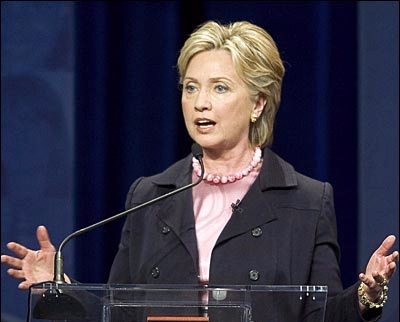


2. Hillary Clinton

As First Lady of the United States, a US Senator, and a hugely popular candidate for President of the US, Hillary Clinton has been a trail blazer for women in politics. Having come closer to being nominated for President by a major party than any woman before her, Senator Clinton has encouraged women to join the political process and pursue their dreams.

For better or worse, and whether you’re her biggest fan or her staunchest critic, Hillary Clinton is probably the most recognized woman in American politics (though perhaps lately eclipsed by Sarah Palin). As her husband’s second term as President drew to a close, Hillary succeeded in being elected US Senator from the state of New York, making her the first First Lady in US history to run for (and win) an elected office.

During her second term as Senator, Hillary announced her candidacy for President. This made her not only a well-known woman politician, but the first woman in the US with a legitimate chance at winning the Oval Office. Though she failed to win the Democratic party’s nomination, she came closer than any woman had before her.

It is evident from the support she received from women across the country that her candidacy was an inspiration to women everywhere. It has even been speculated (and refuted) that the Republican party nominated a woman for the VP slot in response to Hillary’s candidacy. Love her or hate her, there’s no doubt that Hillary Clinton has been influential both in the political arena and in encouraging women to pursue elected offices.

Hillary Clinton will be Barack Obama's Secretary of State, which means she will managing with the affairs of the United States overseas, especially in Iraq and Afghanistan.



3. Sonia Gandhi

Sonia Gandhi is the President of the Indian National Congress and leader of the United Progressive Alliance — the ruling party in the lower house of India’s Parliament. Her position in government is one of the highest offices in the world’s second most populous nation (the most populous democratic nation).

Gandhi would have been the Prime Minister of India, except that in a surprise move she turned down the position when it was offered to her, choosing instead to retain her position in the nation’s legislature. She’s no stranger to the office, however; her husband, Rajiv, served as India’s Prime Minister from 1984-1989. He was assassinated in 1991, which was determined to have been carried out by the Tamil Tigers in retaliation for his sending peace-keeping troops into Sri Lanka. He himself had gained the position after the assassination of his mother by her own Sikh bodyguards. It seems understandable, then, that Sonia Gandhi would turn down the office, perhaps believing that she might have a better chance at helping her nation from the legislature.

Although she is not India’s Prime Minister, Gandhi exerts an enormous amount of political power in the world’s most populous democracy. It was she who nominated the current Prime Minister, Manmohan Singh. Her son, Rahul, also won his bid for Parliament. All this, despite the fact that Sonia Gandhi is not originally from India. The daughter of ethnically Indian parents, she was born and raised in Italy and educated in the UK. She emigrated to India upon marrying Rajiv Gandhi, and yet her popularity among the Indian people has propelled her to the heights of power. Had she accepted the PM position, she would have been the Hindu nation’s first Roman Catholic leader.

Sonia Gandhi’s popularity is evidence that nations can overcome prejudices of gender roles, religion, and ethnicity in leadership, when the person in that position pursues the good of that nation over their own political ambition.


4. Indra Nooyi

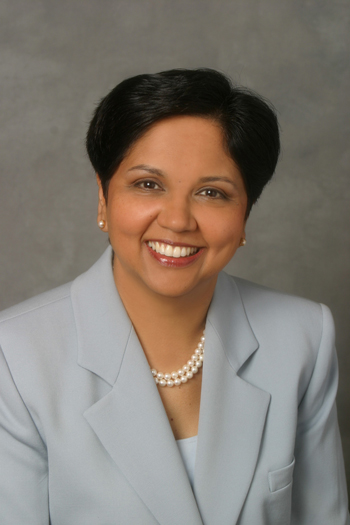
As the CEO of PepsiCo, the world’s 4th largest food and beverage company, Indra Nooyi has won back-to-back listings as a “World’s Most Powerful Woman”. In addition to serving as PepsiCo’s CEO, Nooyi was instrumental in the establishment of Yum! Brands, which now operates Taco Bell, KFC, Pizza Hut, Long John Silver’s, and A&W Restaurants. Yum! Brands is currently listed as a Fortune 500 company and is the world’s largest fast food corporation.

Indra Nooyi started working for PepsiCo in 1994, and became the company’s president and CFO in 2001. Five years later, she was named the company’s CEO, and has been credited with revitalizing the company. Since she started working as CFO, PepsiCo’s revenues have increased by over 70%. Impressively, under Nooyi’s leadership PepsiCo surpassed Coca-Cola in market value for the first time in history.

If it can be said of anyone, it can be said of Indra Nooyi that she has mad business skills. But not only has she improved PepsiCo’s profits margins, she has also implemented business practices that encourage the production of healthier foods and has sought to make the production of the company’s goods more eco-friendly. She has also presided over PepsiCo’s introduction into more foreign markets, which has led to job production in those countries.

Improving business, creating jobs, making healthier foods, and having less impact on the environment -– it’s all in a day’s work for one of the most powerful businesswomen in the world.


5. Christiane Amanpour

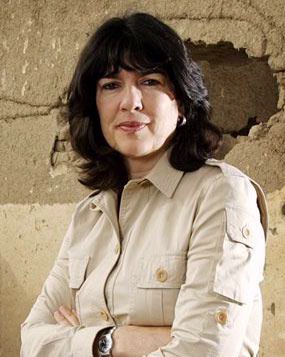
Currently working as CNN’s Chief International Consultant, Christiane Amanpour is most widely known for her up-close coverage of the Middle East, beginning with the Gulf War in 1990. She is widely recognized as one of the most influential international correspondents in the world, due partly to her willingness to report from dangerous situations, usually in war-torn areas.

Amanpour began her journalistic career with CNN, covering events in Germany that signaled the end of the Cold War. She got her “big break” during the Gulf War as one of CNN’s most recognized correspondents. She later covered the conflict in Bosnia, and has since been famous for reporting from active war zones.

Amanpour has also seen controversy, however. She has interviewed the late Yassar Arafat, as well as current President of Iran Mahmoud Ahmadinejad, both of whom had less-than-friendly views toward the US and its allies. The latter interview caused some to fear for her life, since as a young child she and her family had fled from Iran, her native country.

What Christiane Amanpour has contributed, however, and continues to contribute, is a bold and honest look into some of the most difficult situations in the world. She also stands as an example of the strength, courage, and character that a woman journalist can have in the most tense of situations.



6. Cristina Fernandez de Kirchner

Argentina’s first elected female President, Fernandez de Kirchner presides over the government of the second-largest country in South America, and one of the fastest-growing economies in the world. President Kirchner serves as an example to women everywhere that they have the ability to lead a nation through hard times and political turmoil, as well as through economic growth and sensitive diplomatic relations.

Before being elected President of Argentina, Fernandez was a Senator, and then the nation’s first lady; her husband, Nestor, was elected President in 2003. As first lady, Fernandez was active in her husband’s administration, serving as an ambassador and making public speeches. Instead of running for reelection, President Kirchner supported his wife’s candidacy, and she was elected in 2007.

Fernandez’ administration, though short, has not been without controversy. She has been criticized for having a close relationship with the dictator-run government of Venezuela, and has faced protests from Argentina’s farming community over tax policies. Her government has also been accused of failing to root out corruption and for appearing to discourage independent journalism.

But President Fernandez is just getting started, and hopes persist that she will bring invigorating changes to Argentina’s economy and political climate. She certainly has the potential, and the power.


7. Michelle Bachelet

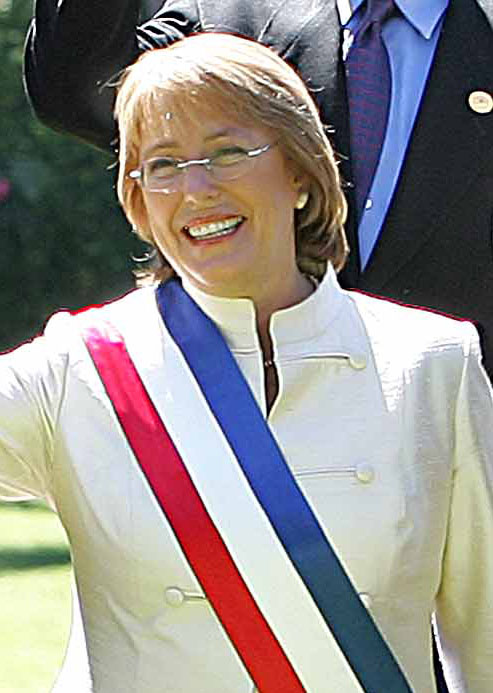
As President of Chile, Veronica Michelle Bachelet Jeria has revolutionized trade relations between nations of South America and Asia-Pacific. She enacted free trade agreements with China (the first between China and a Latin American nation), Japan, India, New Zealand, Singapore and Brunei, and held talks with Australia, Vietnam, Turkey, and Malaysia. Many of these agreements were unprecidented, and have changed the course of her nation’s economic future.

President Bachelet didn’t start out in a great position to become her nation’s leader, however. As a young woman in her 20s, she and her family were imprisoned and tortured by the authorities of Chile’s totalitarian regime. Her father didn’t survive. Upon their release, she and her mother fled to Australia. From there Bachelet pursued her education in Europe in the field of medicine. Before she finished her studies, however, she was given permission to return to Chile. She did so, and learned upon her arrival that her college credits would have to be re-earned. She dug in and finished her degree, becoming a medical doctor. During this time she also began to participate in calls for democracy in her native country.

Bachelet’s political career began after democracy came to Chile in 1990; she started out working at the Ministry of Health. During this time she took up an interest in military strategy, which led to her studying at the Inter-American Defense College in Washington, D.C., and at the Chilean Army’s War Academy. She was appointed Minister of Health, and then Defense Minister, making her the first woman in a Latin American nation to hold that position. While serving as Defense Minister, Bachelet’s popularity grew, until she was elected President in 2005.

During her term as President Bachelet has succeeded in implementing numerous policies in her nation, both foreign and domestic. Her election and administration is said to have been the catalyst for cultural changes in Chile, both in terms of women’s equality and the nation’s political and economic climate in general. Her actions in the realm of free trade agreements have also revolutionized the areas of trade for an entire region of the world.
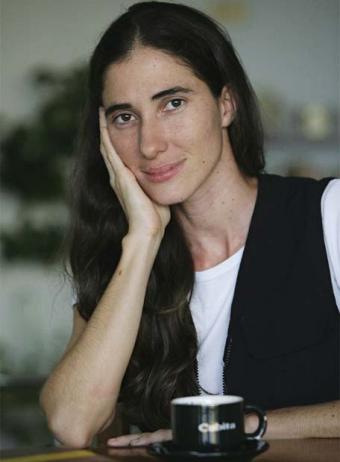


8. Yoani Sanchez

Not allowed to work openly as a journalist, Yoani Sanchez has persisted in covertly publishing unbridled observations and reports about her native Cuba via the Internet. She uses her blog, Generacion Y, to communicate with the world in a way that she ordinarily would never have been able to. She won the Ortega and Gasset Journalism Award in Spain, but was forbidden to travel to the ceremony. Through the Internet, however, Sanchez continues to practice her journalistic dream.

Though she calls her blog “an exercise in cowardice,” Generacion Y is anything but. Sanchez makes unabashed observations about life in Havana, Cuba’s capital city. One of her latest posts is about food shortages, in which she responds to tourists’ questions about typical Cuban cuisine with “I don’t remember.” She goes on to describe a common meal as rice flavored with bouillon cubes, and uses the visual image to describe the political climate in Cuba: “pre-digested news” and “canned speeches”.

Of course, she does not publish or promote her work in her native Cuba. There, she is merely a Spanish teacher for tourists. She publishes her blog from Internet cafes, hoping to stay below the radar of Cuban officials. What she has done, however, is provide an outlet for one citizen’s unedited descriptions of real life in Cuba, defying a totalitarian regime, profit-seeking media, and agenda-pushing politicians.

Generacion Y is a window into a socialist state, complete with propaganda campaigns and highly-restricted access to outside news sources. Having lived in Switzerland for 2 years because of “disillusionment and economic frustration,” Sanchez gained exposure to outside sources of news and history, which no doubt have allowed her to compare life and politics in Cuba to that of other nations. Those years also allowed her to learn the skills needed to build a blog –- a blog that she now uses to share the struggles of the people of Cuba with the rest of the world, filter-free.
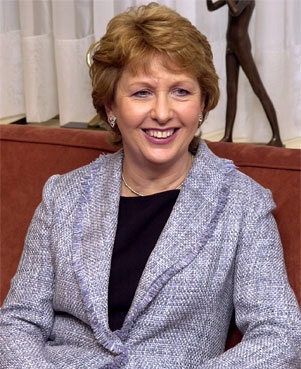


9. Mary McAleese

As President of the Republic of Ireland, Mary McAleese presides over one of the fastest-growing economies in Europe. Enjoying a incredibly high approval rating, she ran for re-election to the Republic of Ireland’s presidency without any opposition. Aside from seeing her nation grow economically, President McAleese has worked to improve relations between Catholics and Protestants in the once-war-torn country, including making regular visits to UK-controlled Northern Ireland.

As a child and young woman Mary McAleese was well acquainted with The Troubles in Northern Ireland –- violent conflicts between Catholics and Protestants over the political status of the country (to join the Republic of Ireland or remain part of the UK, respectively). She left Northern Ireland to pursue a career as a lawyer in the Republic, later becoming a Reid Professor at Trinity College in Dublin. Her professorship led to diplomatic opportunities, launching her into the political arena.

In 1997 McAleese was elected President of the Republic of Ireland, and won re-election in 2004 –- her approval ratings were so high that no political party wanted to spend the money to run a campaign against her. One of the high points of President McAleese’s administration has been the cooling of tempers between opposing factions on the island of Ireland. She is said to be a popular figure in both Northern Ireland and the Republic.

Another of her achievements has been to encourage and realize investment, growth of business, and economic improvement in the nation; Ireland currently enjoys the second highest income per capita in the European Union.

McAleese is currently the longest-serving woman president in the world.
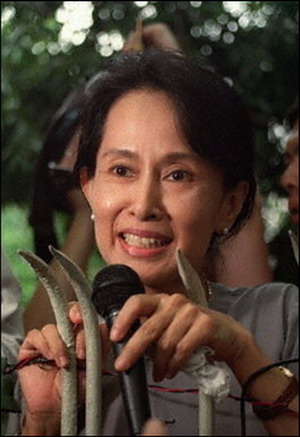


10. Aung San Suu Kyi

Having fought courageously for human rights and democracy, Suu Kyi is the world’s only Nobel Peace Prize recipient currently imprisoned. She is the leader of the National League for Democracy in Burma, and has been imprisoned by the country’s military dictatorship off-and-on since July of 1989. Advocating nonviolent resistance in the tradition of Mohandas Gandhi and Dr. Martin Luther King, Jr., Suu Kyi has refused to accept freedom in exchange for banishment from her country. She was awarded the Nobel Peace Prize in 1991.

Suu Kyi’s father was a general in the Burmese army, and it was he who negotiated Burma’s independence from British rule. However, he was assassinated shortly thereafter. Suu Kyi went abroad to study Philosophy, Politics, and Economics, and returned to Burma in 1988. At that time, a transition of government was taking place in the country, and demonstrations in favor of democracy clashed with a military takeover. Seeing the direness of the situation, Suu Kyi founded the National League for Democracy in Burma (NLD), rallying citizens and making public speeches in favor of establishing a democratic government. The next year she was placed under house arrest.

In Burma’s 1990 general election, the NLD won overwhelmingly, and Suu Kyi officially had the right to assume the post of Prime Minister of Burma. However, the military leadership refused to acknowledge the election, and Suu Kyi was rearrested. In 1995 she was given permission to leave the country, on the grounds that she would never be allowed to return. She refused. Her husband and children were forbidden to enter the country to visit her. In recent years various organizations, including the UN, have attempted to negotiate Suu Kyi’s release, all to no avail; today she remains under house arrest.

Though she is not famous outside of some small circles, Aung San Suu Kyi is a living symbol of peaceful demonstration and civil disobedience in her country, as Gandhi was in India and Dr. King in the United States. What will become of her efforts, however, remains to be seen.
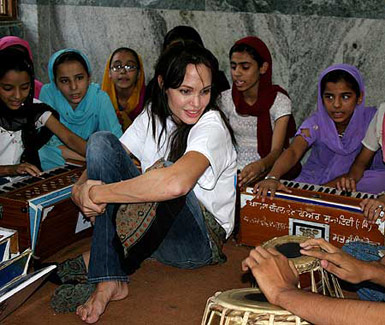


11. Angelina Jolie

A star of stage and screen, Angelina Jolie is perhaps most influential in her role as a UN High Commissioner for Refugees Goodwill Ambassador, advocating on behalf of refugees around the world. Angelina is an example of using the influence one has gained through Hollywood to draw attention to the needs of those in less-fortunate circumstances. While others may talk about world issues, Angelina puts rubber to the road. Not only does she directly impact the communities in which she works, but she inspires others to get actively involved as well.

Angelina’s humanitarian work began after seeing poverty and the effects of war in Cambodia, while filming for Lara Croft: Tomb Raider. She contacted the UN to learn more about impoverished and war-torn areas, making several trips to nations in Africa and Asia to see for herself. As her involvement increased, the UN named her a UNHCR Goodwill Ambassador, in the hopes that she would build awareness and inspire people to take action.

In this role, Angelina has taken more steps than many other “conscious celebrities”, many of whom talk up problems in the world but decline to get involved themselves. She has taken flak from a lot of people for adopting foreign orphans, but having seen the difficult lives children in those circumstances lead, it is not difficult to imagine why she would take the opportunity to provide a more comfortable home for some of them.

Angelina has also been under a lot of scrutiny for her “unique” lifestyle, including a multitude of strange tattoos, odd (often sexual) public behavior, and her preference for maintaining estrangement from her father. Many people may not take these as examples of a great role model. However, when it comes to practicing what you preach, Angelina is one of very few famous examples.
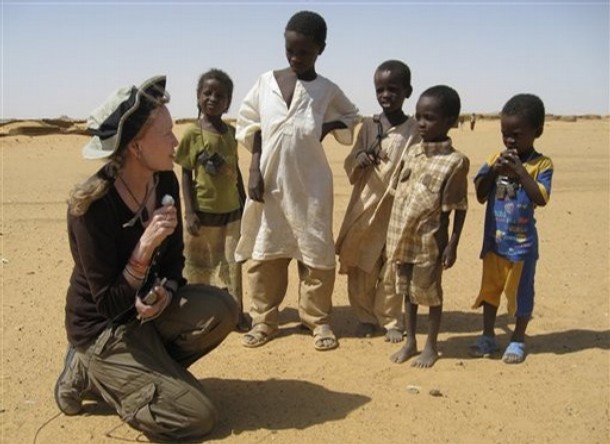


12. Mia Farrow

An actress and activist, Mia Farrow serves as a United Nations Children’s Fund Goodwill Ambassador, advocating for children’s rights in impoverished and war-torn areas of the world. She has also been influential in raising awareness about Darfur (a region of Sudan whose citizens are facing genocide). Part of her work in this area includes focusing attention on China’s role in the conflict, which was brought to light during the 2008 Summer Olympics in Beijing. Through her influence, acclaimed director Steven Spielberg withdrew from being an artistic advisor for the Games, which itself increased public awareness about the issue.

Among other causes, Mia Farrow has worked to raise awareness and support for the fight against polio, which still affects people in some areas of Africa and Asia, but which has now been nearly eradicated; and the conflict in Darfur, which has killed an estimated hundred thousand people or more. Farrow has been a proponent of divestment from Sudan -– withholding business investments and practices with that nation’s government on the grounds that it provides financial and logistic support for those conducting violent acts against civilians.

Farrow has also joined others in calling on divestment from certain Chinese corporations, on the grounds that they do a significant amount of business with Sudan without regard for their poor stance on human rights. Farrow’s efforts have enlisted wide support for raising awareness on the current situation in Darfur and in calling for divestment. She has made numerous trips to the region to see the conflict for herself and to provide exposure to the conflict.

Similar to Angelina Jolie in this respect, Mia Farrow is one of few celebrities who have used their time, energy, and resources to get involved in the causes they espouse, and her influence has been tangible.



13. Barbara Walters

When it comes to news and special reports, no other woman is better recognized than Barbara Walters, a fixture on American television doing work on The View, Today, 20/20, ABC Evening News, and more recently ABC World News Tonight. Barbara was the first woman to be named co-anchor of a network evening news program, paving the way for future female journalists.

Walters’ career began in the 60s, working as a writer and researcher for CBS and NBC. She was soon tasked with reporting on light stories, and quickly moved up to doing her own stories and interviews. She managed to work her way to the top, only to stop short of achieving equal footing when her coworker made certain demands: he would the right to ask the first question when conducting interviews, she would not be given the title of “anchor”, etc. It was not until his death in 1974 that Walters was given the title of “co-anchor”. And even then, she was the subject of animosity among some of her co-workers.

Nevertheless, Walters’ career continued to thrive, and she was even chosen to moderate one of the Presidential debates between Jimmy Carter and Gerald Ford. She also continued to do numerous specials and memorable interviews with celebrities and world leaders.

Currently, Barbara Walters co-hosts the all-women panel of The View, which she describes as a place for women of “different generations, backgrounds, and views.” The show has enjoyed enormous success, albeit with a dose of controversy, and provides a forum for women to discuss the world from their point of view.

For all that she has been through, Barbara Walters is a true pioneer among women, breaking the glass ceiling in the world of TV journalism.
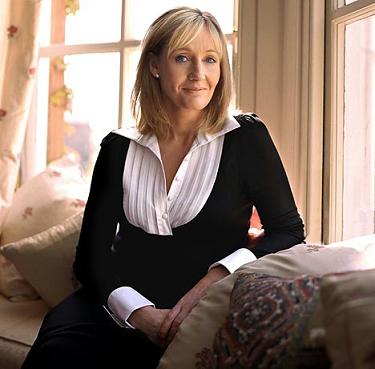


14. JK Rowling

A British author known for the Harry Potter series, which have sold more than 400 million copies worldwide and won numerous awards, JK Rowling has become one of the world’s most successful and influential novelists. Aside from her literary work, Rowling has established and contributed to charitable organizations to fight poverty and social inequality throughout the world.

Taking inspiration from real events in her own life, including her school days, the death of her mother, and struggles in her personal and professional life, JK Rowling was inspired to write the story of Harry Potter, a young boy growing up under difficult circumstances who suddenly finds himself being invited to attend a magical school. The succeeding books (7 total) have become some of the most beloved and successful (and controversial) in the world –- she is the first person in the world to become a billionaire (in US dollars) just from authoring books.

Since becoming so wealthy, Rowling has donated funds to several different charities, especially in the areas of poverty and multiple sclerosis (the disease from which her mother died). Her contributions, as well as her volunteer work, have been an example to millions of young readers.

Rowling has been criticized by many for the nature of her books, with many accusing her of promoting witchcraft among children. Rowling denied the claims, but made no statement about the role of religion or belief as she was writing her books. Since publishing the final book, however, Rowling has stated that she is a Christian, but that she didn’t want to publicize her faith until the books had all been published. Her reason for this was that she was afraid that people would be able to “guess what’s coming in the books.” Don’t worry, you won’t get any spoilers from me.



15. Meg Whitman

If you’ve ever heard of Hasbro, Playskool, Mr. Potato Head, Disney, Procter & Gamble, or eBay, you’ve been influenced by Meg Whitman, who is considered one of the most powerful corporate executives in the world. Having joined eBay as the company’s Chief Executive Officer in 1998, she saw the company grow from 30 employees to over 15,500, with revenue growing from over $4 million to over $8.64 billion. Meg Whitman is a prime example of how a woman can succeed in business.

Meg Whitman is also an example of how important entrepreneurial ingenuity and integrity are in growing a stable business, creating new jobs, and using advances in technology to establish new industries. Whitman’s keen business sense and ability to thrive in unfamiliar territory have even brought her into the political arena, with Republican presidential nominee John McCain naming her as a potential Treasury Secretary.

She may not be interested in the position, however; Ms. Whitman has hinted at running for Governor of California in 2010. She has already hired advisors to look into it. If she is elected, she would be the first woman to serve as governor of California.

Named one of the most powerful persons in the world, Meg Whitman has exerted influence over the business world, the Internet, economics, and politics. Her example is an encouragement to women everywhere who have hopes of succeeding in new areas of business.
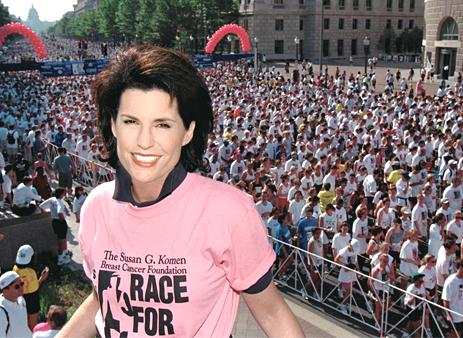


16. Nancy Brinker
The sister of a breast cancer victim, Nancy Brinker founded and organized “Race for the Cure” and the Susan G. Komen Foundation (named for her sister), and rallied more than 1,000,000 supporters from around the world. Breast cancer mortality rates have decreased significantly as a result of her work. In 2007 she was appointed Chief of Protocol of the United States, a role in which she advises, assists, and supports the administration of the US on official matters of diplomatic procedure. She herself is a breast cancer survivor, and continues to serve on the board of the Foundation she established.

Lots of people see tragedies and think, “Something should be done about that.” Nancy Brinker went out and did it. After her sister died of breast cancer in 1982, Brinker established Susan G. Komen for the Cure in her honor. Today it is the largest breast cancer-related charity in the United States, and has affiliate organizations in 122 countries around the world –- quite an achievement for a woman who started out working for Neiman Marcus.

Her success in both business and the founding of a successful and effective charity organization brought her to the attention of the White House, and she was nominated to be the US Ambassador to Hungary in 2001. She served in that office until 2003. In 2007 she was appointed Chief of Protocol of the US, under the State Department, for which still holds the title of Ambassador. Aside from advising the administration, Ambassador Brinker is the face of the White House to diplomats visiting the US.

How many women have had the opportunity to be so influential in two entirely independent roles?
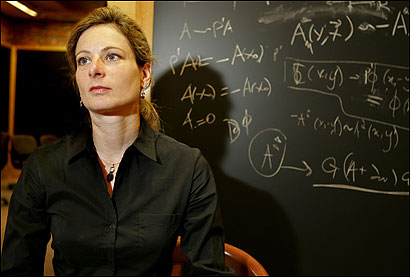


17. Lisa Randall


The first women ever tenured in the physics departments of Princeton, MIT, and Harvard, Lisa Randall is hard at work in the areas of particle physics and cosmology, part of a journey to determine the makeup of the universe. In 2004 she held the distinction of being the most cited theoretical physicist of the past five years. She continues to do ground-breaking research in particle physics and cosmology, and currently serves on the editorial boards of several theoretical physics journals.

Some of Randall’s most exciting work involves the concept of higher dimensions. 3D? How quaint. One of her more revolutionary ideas is that “we might be living in a 3-D sinkhole in a higher-dimensional universe.” In more practical terms, her research is helping to provide the key to learning why gravity isn’t as strong as current physics theories say it should be.

If you’ve ever heard of the Large Hadron Collider, which was powered up for the first time this year, you’ll be impressed to learn that some of Randall’s research is just the kind of thing that the LDC is being used to test. Not only are her theories intriguing, but they are now capable of being tried and tested. She is also working with some of NASA’s instruments to test some of her theories.

In short, Randall is a pioneer in the modern world of theoretical physics, and she’s paving the way for current and future scientists in a field that still has many more questions than answers.
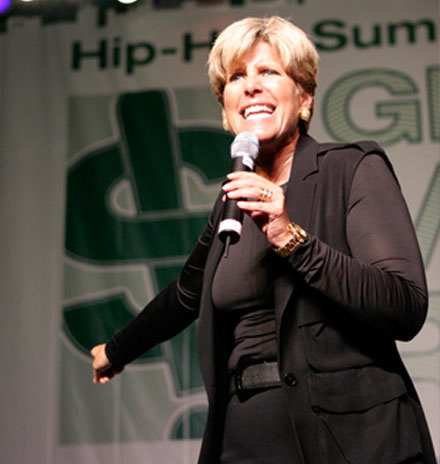


18. Suze Orman

Having written 6 consecutive New York Time’s Bestsellers, and as host of her own show on CNBC, Suze Orman has encourage millions across America who are battling with their finances. She has also been the single most successful fund raiser in history for public television and is the top seller on home shopping network QVC. Her popularity and success has inspired more women to enter the financial sector.

The financial sector was not the most obvious destination for Suze Orman to take her career. In college she majored in social work, ending up working as a waitress in California. One day, a favorite customer loaned her $50,000 to help her establish her own restaurant. She tried to invest the money, but her stock broker pulled a con and took it. She decided to take matters into her own hands and enrolled in Merrill Lynch’s training program.

She was subsequently hired by the investment firm, and became so successful at the job that she was offered the position of VP of investments at Prudential. She left Prudential to start her own firm, then left active work there to pursue writing. Since then Suze has found success in books and television, both as a financial advisor and as a saleswoman.

Suze’s success in the world of finance has opened new doors for women in the financial and investment sectors. She has shown that a woman does have what it takes to make it in those tough industries, and has paved the way for women in those fields.



19. Pat Head Summitt

Coach Summit began coaching the University of Tennessee Lady Vols basketball team in 1974, and has since become the all-time winningest coach in the history of NCAA basketball. She has also authored two books, been inducted in to the women’s Basketball Hall of Fame, and is the only person to have two NCAA Division I basketball courts named in her honor. Her dedication and success in the field of women’s sports has encouraged young women everywhere to pursue their athletic dreams.

Coach Summitt has been with the Lady Vols 1974 -– a long record for any coach. She herself was an Olympic women’s basketball player, competing in the 1976 Games (the team won silver). Under her tutelage the Lady Vols have appeared in every NCAA Tournament –- ever. In 2008 the Lady Vols won their 8th consecutive national championship. Several of her players have gone on to play professional basketball in the WNBA.

Coach Summitt’s legacy is grand, though it’s not over yet. There are no signs of her retiring in the immediate future. Already the winningest coach in NCAA basketball, she continues to drive her team forward. She has also authored two books: Reach for the Summitt and Raise the Roof. The first is an autobiography laced with motivation and inspiration, while the latter is about her team.

Coach Summitt is a living legend in the world of women’s sports. She has never been one to give speeches, or make protests, or call foul, but she has arguably done more for women in sports than any woman before or after her. And she’s still out there on the court doing what she loves –- taking her team to victory.
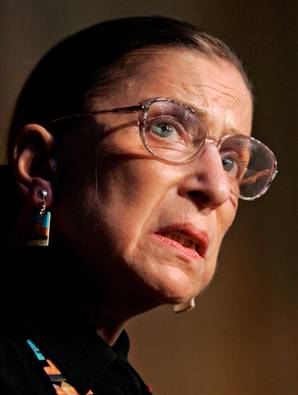


20. Ruth Bader Ginsburg

The only woman currently serving on the US Supreme Court, Justice Ginsburg exercises influence over the laws that govern the United States. Like Justice O’Connor before her, Justice Ginsburg helps make the decisions of the highest court in the US, making her not only one of the most influential, but one of the most powerful women in the world. One way her influence can be shown is in the presidential debate: it has been said that whoever becomes president will be pressured to appoint a woman to the Court to replace her when she retires.

One of the most influential parts of Justice Ginsburg’s appointment to the court is in what is now called the “Ginsburg Precedent”. During her confirmation hearings, she refused to answer some questions posed by the Senate Judiciary Committee. Most of the questions she refused had addressed her personal opinions on certain issues that could potentially come before the court, including abortion, civil rights, gun control, school vouchers, separation of church and state, and several other issues.

Years later, when John Roberts and Samuel Alito sat before the same committee for their own confirmation hearings, each cited the Ginsburg Precedent as justification for not answering similar questions. The concept behind the precedent is that a Supreme Court Justice should go into any case impartially, with no pre-formed opinion of how they intend to decide, so that their rulings are based on the law and the Constitution, rather than their own personal ideals.

Even without the Ginsburg Precedent affecting the future of the appointment of Supreme Court Justices, Ruth Bader Ginsburg is influential solely on the basis of her position in the Court. Her decisions and opinions provide legal precedent for the US now and for generations to come.


Enemy of the Internet


I got some lists of companies that supports SOPA. If you wanna join our cause kindly contact their company that you don't support this bill (if you are in America) and boycott their products or services.
List of Supporters: H.R. 3261, the  Stop Online Piracy Act

60 Plus Association: info@60plus.org
Alliance for Safe Online Pharmacies (ASOP): 703-539-ASOP (2767)
American Federation of Musicians (AFM): presoffice@afm.org
American Federation of Television and Radio Artists (AFTRA): (212) 532-0800
American Society of Composers, Authors and Publishers (ASCAP): atoczylowski@ascap.com
Americans for Tax Reform: ideas@atr.org
Artists and Allied Crafts of the United States: iatsepac@iatse-intl.org
Association of American Publishers (AAP): asporkin@publishers.org
Association of State Criminal Investigative Agencies: bob@mcconnell.net
Association of Talent Agents (ATA): rnoval@agentassociation.com
BMG Chrysalis: info@bmg.com
Capitol Records Nashville: ann.inman@emimusic.com and brent.jones@emimusic.com
Cengage Learning: (800) 354-9706
Christian Music Trade Association: 615-242-0303
Church Music Publishers' Association: (615) 791-0273
Coalition Against Online Video Piracy (CAOVP): (212) 485-3452
Comcast/NBCUniversal: info@comcast.com
Concerned Women for America (CWA): (202) 488-7000
Congressional Fire Services Institute: update@cfsi.org
Copyright Alliance: info@copyrightalliance.org
Council of Better Business Bureaus (CBBB): (703) 276-0100
Council of State Governments: membership@csg.org
Country Music Association: communications@CMAworld.com
Country Music Television: info@cmt.com
Covington & Burling LLP: http://www.cov.com/contactus/
Cowan, DeBaets, Abrahams & Sheppard LLP: info@cdas.com
Cowan, Liebowitz & Latman, P.C.: law@cll.com
Directors Guild of America (DGA): (310) 289-2000 or (800) 421-4173
Disney Publishing Worldwide, Inc.: (212) 633-4400
EMI Christian Music Group: (615) 371-4300
EMI Music Publishing: (212) 492-1200
Estée Lauder Companies: (212) 572-4200
Fraternal Order of Police (FOP): pyoes@fop.net
Go Daddy: (480) 505-8800
Gospel Music Association: service@gospelmusic.org
Graphic Artists Guild: president@gag.org
HarperCollins Publishers Worldwide: feedback2@harpercollins.com or (212) 207-7000
Independent Film & Television Alliance (IFTA): http://www.ifta-online.org/contact
International Alliance of Theatrical and Stage Employees: See Artists and Allied Crafts
International AntiCounterfeiting Coalition (IACC): iacc@iacc.org
International Brotherhood of Electrical Workers (IBEW): (202) 833-7000
International Brotherhood of Teamsters: http://www.teamster.org/content/contact-us
International Trademark Association (INTA): customerservice@inta.org or
communications@inta.org
International Union of Police Associations: iupa@iupa.org
Irell & Manella LLP: info@irell.com
Jenner & Block LLP: (312) 222-9350
Kelley Drye & Warren LLP: http://www.kelleydrye.com/contacts/index
Kendall Brill & Klieger LLP: (310) 556-2700
Kinsella Weitzman Iser Kump & Aldisert LLP: info@kwikalaw.com
L'Oreal: (212) 818-1500
Lost Highway Records: (615) 524-7500
Macmillan: (646) 307-5151
Major County Sheriffs: jrwolfinger@mcsheriffs.com
Majority City Chiefs: dstephens@carolina.rr.com
Marvel Entertainment: (212) 576-4000
MasterCard Worldwide: (800) 622-7747
McGraw-Hill Education: customer.service@mcgraw-hill.com
Minority Media & Telecom Council (MMTC): info@mmtconline.org
Mitchell Silberberg & Knupp LLP: http://www.msk.com/contact/
Motion Picture Association of America (MPAA): contactus@mpaa.org
Moving Picture Technicians: See Artists and Allied Crafts
MPA – The Association of Magazine Media: mpa@magazine.org
National Association of Manufacturers (NAM): manufacturing@nam.org
National Association of Prosecutor Coordinators: (518) 432-1100
National Association of State Chief Information Officers: svaughn@AMRms.com
National Cable & Telecommunications Association (NCTA): webmaster@ncta.com
National Center for Victims of Crime: http://www.ncvc.org/ncvc/main.aspx?
dbID=DB_Contact764
National Crime Justice Association: info@ncja.org
National District Attorneys Association: (703) 549-9222
National Domestic Preparedness Coalition: info@ndpci.us
National Football League: http://www.nfl.com/contact-us
National Governors Association, Economic Development and Commerce Committee:
webmaster@nga.org
National League of Cities: http://www.nlc.org/about-nlc/contact-nlc
National Narcotics Offers' Associations' Coalition: rmsloan626@verizon.net orhttp://www.natlnarc.org/default.aspx?page=1011
National Sheriffs' Association (NSA): http://sheriffs.org/content/contact-us
National Troopers Coalition: info@ntctroopers.com
Patterson Belknap Webb & Tyler LLP: http://www.pbwt.com/contact/
Penguin Group (USA), Inc.: ecommerce@us.penguingroup.com
Pharmaceutical Research and Manufacturers of America: newsroom@phrma.org
Proskauer Rose LLP: info@proskauer.com
Provident Music Group: (615) 261-6500
Robins, Kaplan, Miller & Ciresi LLP: http://www.rkmc.com/Contact.aspx
Screen Actors Guild (SAG): saginfo@sag.org
Shearman & Sterling LLP: website.administration@shearman.com
Simpson Thacher & Bartlett LLP: (212) 455-2000
Skadden, Arps, Slate, Meagher & Flom LLP: info@skadden.com
Sony/ATV Music Publishing: info@sonyatv.com
State International Development Organization (SIDO): sido@csg.org
The National Association of Theatre Owners (NATO): nato@natodc.com
The Perseus Books Groups: (800) 343-4499
The United States Conference of Mayors: info@usmayors.org
Ultimate Fighting Championship (UFC): info@ufc.com
UMG Publishing Group Nashville: (615) 340-5400
United States Chamber of Commerce: http://www.uschamber.com/about/contact/submit-
question
Universal Music: communications@umusic.com
Universal Music Publishing Group: umpg.newmedia@umusic.com
W.W. Norton & Company: (212) 354-5500
Warner Music Group: http://www.wmg.com/contact
Wolters Kluewer Health: customerservice@lww.com
Word Entertainment: wordtech@wbr.com

source: gizmodo.com